

💬 Consult Now
Hi, How Can We Help You?

Category Archives: Company REgistration

September 28, 2026

Three Ways to Expand Your Business to the USA

A Guide to Business Immigration Options

For Indian entrepreneurs and business owners, entering the American market is often less about starting from scratch and more about choosing the right legal pathway to move people, leadership, or capital across borders. U.S. immigration law offers several routes for this, but three stand out as the most commonly used by companies looking to establish, grow, or invest in a U.S. presence: the L-1 visa, the EB-1C visa, and the EB-5 visa. Each serves a different purpose, comes with its own eligibility criteria, and leads to different long-term outcomes. Understanding how they differ, and how they can work together, is essential for any business owner planning a serious move into the U.S. market.


1. Expanding Through People: The L-1 Visa

The L-1 visa is designed for companies that already have an established business outside the United States and want to open, run, or grow a U.S. office by transferring their own staff, rather than hiring locally from day one. It is a non-immigrant visa, meaning it is temporary in nature, but it is one of the most flexible and widely used tools for cross-border business expansion because it does not require a labor certification or proof that no qualified American worker is available for the role. The employer simply needs to demonstrate a genuine business need and a qualifying relationship between the overseas company and the U.S. entity.

There are two categories under the L-1 visa. The L-1A is for executives and managers, and covers individuals who will direct the organization, a major function within it, or a team of professional employees. This is typically the category used by business owners themselves, or by senior leadership being sent to establish and run the U.S. operation.

The L-1B is for employees with specialized knowledge, meaning individuals who possess an advanced level of expertise in the company’s products, services, research, systems, or processes that is not commonly found in the broader labor market. This category is often used for technical staff, engineers, or subject-matter experts whose knowledge is critical to setting up or operating the U.S. business.

To qualify for either category, the employee must have worked for the overseas company for at least one continuous year within the three years immediately preceding the application. The overseas and U.S. entities must also have a qualifying relationship, such as parent and subsidiary, affiliate, or branch office, and both entities must be actively doing business, not simply holding an office on paper.

One of the most valuable features of the L-1 visa is the new office provision, which allows a company that does not yet have a functioning U.S. office to still bring over an executive or manager to establish one. In this case, the initial approval is limited to one year, after which the company must show that the U.S. office is operating, generating revenue, and has hired staff, in order to extend the visa further. This makes the L-1 an ideal entry point for businesses that are serious about a U.S. presence but are still in the early stages of building it.

Once approved, the L-1A visa can be extended up to a maximum of seven years, while the L-1B can be extended up to five years. Spouses of L-1 visa holders receive L-2 status, which allows them to apply for work authorization in the U.S., and children can attend school on the same dependent status. Perhaps most importantly for long-term planning, L-1A status creates a natural and efficient bridge to permanent residency, because L-1A executives and managers are the exact profile targeted by the next category: the EB-1C visa.

2. From Transfer to Green Card: The EB-1C Visa

While the L-1 visa is temporary, the EB-1C is an immigrant visa category, meaning it leads directly to a Green Card from India. It is specifically designed for multinational executives and managers who have been working abroad for a company that has a qualifying U.S. affiliate, and who now wish to continue in an executive or managerial capacity for the U.S. entity on a permanent basis.

The eligibility requirements mirror those of the L-1A in many respects. The applicant must have worked in a managerial or executive role abroad for at least one year within the three years before filing, and there must be a qualifying relationship between the U.S. company and the overseas entity. The U.S. company must also have been doing business for at least one year at the time of filing. Because of this overlap, the EB-1C is often pursued as the natural next step after an individual has spent time in the U.S. on an L-1A visa, having already demonstrated that the U.S. office is functioning and that the executive role is genuine.

What makes the EB-1C particularly attractive compared to most other employment-based Green Card categories is that it does not require labor certification. Most employment-based immigrant visas require the employer to first test the U.S. labor market and obtain a certification from the Department of Labor showing that no qualified American worker is available for the position. This process, known as PERM, can take well over a year on its own. The EB-1C skips this step entirely, which significantly shortens the overall timeline and reduces administrative burden, making it one of the more efficient employment-based Green Card routes available.

That said, processing times for EB-1C petitions are still subject to the U.S. visa bulletin, which allocates a limited number of Green Cards each year by country of birth. Applicants born in countries with high demand, notably India, may experience longer waiting periods for their priority date to become current, even after the petition itself is approved. This is an important planning consideration, and one where early filing can make a meaningful difference over time.

The outcome of a successful EB-1C petition is significant: a direct, permanent Green Card for the applicant, along with the applicant’s spouse and unmarried children under 21. There is no need to first hold a temporary L-1 visa to qualify for EB-1C, though in practice, many successful applicants do use the L-1A as a stepping stone, since it allows the U.S. business to establish a track record before the permanent petition is filed.

3. Building a Presence Through Capital: The EB-5 Visa

The third major route, and the one most distinct from the other two, is the EB-5 visa. Rather than being based on an employment relationship or a transfer of personnel, the EB-5 is an investment-based Green Card category. It is designed for individuals who are willing to invest a significant amount of capital into a new commercial enterprise in the United States and, in doing so, create jobs for American workers.

The minimum investment threshold depends on the location of the project. For investments made in a Targeted Employment Area, meaning a rural area or a region with high unemployment, the required investment is 800,000 US dollars. For projects outside a Targeted Employment Area, the standard investment amount is 1,050,000 US dollars. In either case, the investment must be at risk, meaning it must be placed into a genuine commercial enterprise with the potential for gain or loss, rather than simply parked in a safe or guaranteed instrument.

The central requirement of the EB-5 program is job creation. The investment must directly or indirectly create or preserve at least ten full-time jobs for qualifying U.S. workers within a defined period. There are two broad ways to meet this requirement. The first is direct investment, where the investor starts or invests in their own business and is directly responsible for creating the required jobs. The second, and by far the more common route among Indian investors, is investment through a Regional Center, which is a USCIS-designated entity that manages larger development projects and pools capital from multiple investors. Regional Center investments allow for a more passive role, since job creation can be counted using indirect and induced employment models, and the investor is not required to be involved in the day-to-day management of the business.

Because EB-5 does not require the investor to work for or manage the enterprise personally, it is often the preferred route for business owners, professionals, or families who want a Green Card primarily for lifestyle, education, or long-term security reasons, rather than to actively operate a U.S. business themselves. It is worth noting, however, that EB-5 approval is initially conditional. Investors and their families receive a two-year conditional Green Card, and must later file a petition to remove the conditions by demonstrating that the required jobs were, in fact, created and that the investment remained at risk throughout the required period.

Like the EB-1C, EB-5 approval extends to the investor’s spouse and unmarried children under 21, making it a strong option for families planning a long-term move. Unlike the L-1 and EB-1C categories, EB-5 does not require any employer sponsorship at all. The investor is entirely self-sponsored, which removes the dependency on an existing overseas business or employment relationship, and opens the door to individuals who may not have a company to transfer staff from, but do have the capital to invest.

Choosing the Right Path

Each of these three categories serves a different kind of business goal. The L-1 visa is best suited to companies that already have an operating business abroad and want to move their own people to establish or grow a U.S. presence, with a realistic path to later convert that presence into a permanent Green Card through EB-1C. The EB-1C is the natural long-term destination for executives and managers who have proven, often through the L-1, that their U.S. operation is genuine and functioning. The EB-5, by contrast, does not depend on an existing business or employment history at all, and instead offers a direct route to permanent residency through capital investment and job creation, making it especially attractive to investors and families seeking a more passive path to a U.S. Green Card.

For many businesses, these routes are not mutually exclusive but sequential. A company might begin with an L-1 visa to establish its U.S. office, and once that office is operating successfully, its executive can pursue an EB-1C Green Card. Alternatively, a business owner without an existing company structure suited to L-1 or EB-1C may find that EB-5 offers the most direct path to permanent U.S. residency for the entire family.

Given the complexity of eligibility requirements, documentation, and processing timelines involved in each of these categories, working with experienced legal counsel from the outset is essential to choosing the right strategy and avoiding costly delays.

4. Bonus Path

There is also a fourth possibility, distinct from all three immigration routes above, for Indian HNIs and UHNIs who want to invest in the United States purely for financial reasons, with no visa or residency expectation attached. This route is suited to investors seeking higher returns, geographic diversification of their portfolio, and a way to build a corpus for their children’s future education abroad. The investment could be in land, real estate or financial market.


Ajmera Law International advises businesses and individuals on global mobility and U.S. business immigration strategy, including L-1, EB-1C, and EB-5 matters.

Contact: Advocate Prashant Ajmera

+91 9974253030  |  prashant@ajmeralaw.com  |  ajmeralaw.com

January 12, 2026

Legal company structures for Global Expansion for

Indian SMEs & Start-Up and EB5 Source of funds


Legal structures empower Indian companies, including SMEs and startups, to expand globally by ensuring regulatory compliance, tax efficiency, and risk mitigation under FEMA rules. These frameworks, from subsidiaries to holding companies, are vital tools for seamless international operations, as demonstrated by giants like Tata and Infosys.

For EB-5 investors, they also streamline source-of-funds documentation, proving lawful origins to USCIS. Our Law firm recently assisted Indian EB5 investors by making a legal structure.

Core Legal Structures for Global Expansion

Indian entities adopt wholly-owned subsidiaries for limited liability and local compliance, branches for operational simplicity, joint ventures for market partnerships, and holding entities in hubs like Singapore for IP centralization and royalties.

Under FEMA Overseas Investment Rules 2022, investments route via automatic approval up to 400% of net worth or LRS (USD 250,000 per individual), avoiding multi-layer limits and prohibited sectors like real estate. POEM rules require foreign boards to meet abroad with independent directors to prevent Indian tax residency. ​

Strategies for SMEs and Startups

Indian SMEs and DPIIT-recognized startups simplify global entry with subsidiaries in the US, UAE, or Singapore, leveraging Udyam registration for export incentives and Startup India for FDI ease.

Initial steps include liaison offices or branches (RBI-notified), progressing to JVs for local expertise, all under bona fide business criteria—no passive investments.

Flipkart’s Singapore holding enabled Walmart integration;

Byju’s US entities fueled edtech growth, optimizing fundraising and compliance.

EB-5 Investors: Structuring Source of Funds

EB-5 applicants use proprietorships, partnerships, or private limited companies to trace funds from profits, gifts, or sales, backed by 5-year tax returns, audited P&Ls, bank statements, and CA certifications.


On the other hand global company structures may provide clean records for USCIS path-of-funds analysis, though dividends incur DDT; partnerships suit family liquidity proofs via LRS or without LRS remittances. FEMA compliance ensures seamless fund transfers abroad, avoiding scrutiny. This may avoid TCS in many cases.

September 22, 2025

Offshore Bank Accounts: Guidelines and Compliance

Effective management of banking and financial transactions is critical for Indian businesses expanding internationally. This module explores the guidelines and practical strategies for opening and operating offshore bank accounts while mitigating financial risks such as currency fluctuations through derivatives and advanced tools.

Regulatory Framework
Under the Foreign Exchange Management Act (FEMA) and Reserve Bank of India (RBI) circulars, Indian entities can establish and operate foreign currency accounts overseas under specified conditions.

Eligibility

  • Indian companies with branches, subsidiaries, or joint ventures abroad 
  • Exporters with active foreign currency inflows 

Approval Process

  • Automatic Route: RBI permits certain offshore accounts without prior approval, for uses like remittance of profits or covering operating expenses. 
  • Approval Route: Special permission is needed for large transactions or unique financial arrangements. 

Permitted Transactions

  • Crediting export receipts 
  • Settling overseas operational expenses 
  • Remitting dividends, royalties, or capital gains 

Documentation

  • Application through an Authorized Dealer (AD) Bank in India 
  • Company resolution, identity verification, business rationale for offshore accounts 
  • Adherence to KYC requirements of the foreign bank 

Currency Risk Management: Hedging Against Volatility

Understanding the Risk
Foreign trade exposes businesses to exchange rate risks, common in export-import, overseas loans, and cross-border investments.

Hedging Tools

  • Forward Contracts: Lock in exchange rates for future transactions 
  • Currency Futures: Exchange-traded contracts to protect against price shifts 
  • Options Contracts: Right (not obligation) to exchange at a specified rate 
  • Swaps: Exchange of cash flows or principal in different currencies 

RBI Guidelines

  • Permits use of derivatives exclusively for hedging, not speculation 
  • Transactions routed through RBI-authorized dealers 
  • Clear documentation, such as invoices or contracts, must justify every hedging transaction 

Practical Considerations for Offshore Banking

Choosing the Right Bank
Evaluate:

  • Local legal and regulatory environment 
  • Transaction fees and foreign exchange charges 
  • Digital banking facilities for cross-border ease 
  • Anti-money laundering (AML) compliance 

Currency Denomination

  • Maintain accounts in major currencies relevant to your trade 
  • Diversify holdings across multiple currencies to balance exposure 

Repatriation of Profits

  • Profits remitted back to India must comply with FEMA 
  • Tax planning is essential to minimize double taxation and withholding tax levies 

Tax Implications and Reporting

Tax Treatment

  • Offshore income must comply with Indian Income Tax Act provisions 
  • Relief can be availed under Double Taxation Avoidance Agreements (DTAA) 

Reporting Obligations

  • Companies must disclose offshore accounts in their annual financial statements 
  • Individual stakeholders must declare foreign assets in their income tax returns, where applicable 

Examples and Case Studies

  • Infosys: Leveraged offshore banking facilities to streamline payroll and supplier payments across international markets. 
  • Tata Steel: Used forward contracts to hedge against USD-INR volatility, protecting margins in global trade. 

Conclusion

This module enables Indian businesses to seamlessly manage international financial operations. By setting up offshore bank accounts in compliance with FEMA, using RBI-approved hedging tools, and adhering to tax reporting obligations, companies can reduce global financial risks. With the right mix of compliance, planning, and risk management, Indian enterprises can safeguard profitability and sustain long-term growth in global markets.

September 15, 2025

Funding Mechanisms: FEMA-Compliant Outbound Investments (ODI) for Funding Foreign Branches or Subsidiaries

Expanding a business internationally often requires substantial capital investment. For Indian companies, this process is governed by the Foreign Exchange Management Act (FEMA) and its regulatory framework on Outbound Direct Investments (ODI). Understanding these rules is essential to fund foreign branches or subsidiaries efficiently while staying compliant with Indian law.

Overview of Outbound Direct Investment (ODI)

Outbound Direct Investment (ODI) enables Indian businesses to establish a global footprint by investing in overseas entities, such as:

  • Wholly-owned subsidiaries (WOS)
  • Joint ventures (JV)
  • Branch offices

This framework is primarily governed by the Foreign Exchange Management (Transfer or Issue of Any Foreign Security) Regulations, 2004. Its objective is to empower Indian entities to compete globally while promoting cross-border business linkages.

FEMA Guidelines for ODI

  • Eligibility Criteria
    • Indian companies, LLPs, partnerships, and proprietorships can make ODI.
    • Individual investors may invest under the Liberalized Remittance Scheme (LRS), albeit within defined purposes and limits.
  • Permitted Activities
    • Investments in JVs and WOS engaged in legitimate business activities.
    • Certain sensitive sectors (e.g., defense, financial services, real estate trading) are restricted or require prior government approvals.
  • Investment Limits
    • Automatic Route: Up to 400% of the investor’s net worth (as per the last audited balance sheet).
    • Approval Route: Applicable where the proposed investment exceeds the 400% cap or falls under restricted categories, requiring RBI’s explicit approval.

Funding Mechanisms Under ODI

Indian companies can fund their foreign affiliates through diverse FEMA-compliant methods:

  • Equity Investment: Direct subscription to shares or capital of the foreign entity.
  • Debt Financing: Loans or guarantees extended to overseas JVs or WOS, subject to RBI’s External Commercial Borrowings (ECB) guidelines.
  • Reinvestment of Retained Earnings: Profits earned abroad can be reinvested locally to support expansion.
  • Transfer of Assets: Tangible assets (plant, machinery, or land) or intangible assets (intellectual property, brand value) converted into capital contribution.

Documentation Requirements

Proper documentation ensures transparency and compliance with FEMA rules:

  • Form ODI – Mandatory reporting format for all outbound investments, filed with Authorized Dealer Banks.
  • Charter Documents of the Foreign Entity – Memorandum and Articles of Association (MoA and AoA).
  • Valuation Reports – Required in cases of acquisitions, mergers, or significant asset contributions.
  • Board Resolutions – Approval from the Indian investing entity’s board of directors.

RBI Approval Process

  • Automatic Route
    • Within prescribed investment limits, filing Form ODI and supporting documentation suffices. Prior RBI approval is not required.
  • Approval Route
    • Required for sensitive sectors or investments breaching the cap.
    • A detailed application, complete with project reports, funding structures, and financial justifications, must be submitted to RBI for clearance.

Tax Implications and Compliance

  • DTAA (Double Taxation Avoidance Agreement): Prevents double taxation of the same income in India and the host country.
  • Transfer Pricing Norms: Arm’s-length pricing must apply to cross-border transactions to avoid tax liability issues.
  • FEMA Penalties: Violations may result in fines, compounding proceedings, or disqualification of the investment.

Practical Considerations for Indian Businesses

  • Sector-Specific Rules: Industries like telecom, insurance, or defense often involve additional scrutiny.
  • Monitoring Investments: Periodic filings and performance updates to RBI help maintain compliance.
  • Strategic Jurisdiction Selection: Choosing countries with investor-friendly tax regimes, stable financial structures, and bilateral treaties can provide significant advantages.

Examples of ODI by Indian Companies

  • Tata Group: Expanded into the US and Europe by acquiring prestigious firms in automobile and IT sectors.
  • Infosys: Established global R&D centers to support innovation and client servicing.
  • Mahindra & Mahindra: Acquired international firms in agricultural machinery and automobiles.

Conclusion

ODI under the FEMA regime serves as a powerful instrument for Indian businesses aspiring to globalize. By leveraging compliant funding mechanisms—equity, debt, reinvested earnings, or asset transfers—companies can expand across borders while ensuring legal security. Robust documentation, tax planning, and regulatory awareness minimize compliance risks while maximizing international growth potential.

September 8, 2025

Intellectual Property Rights: Filing Patents, Trademarks, and Copyrights Internationally


In today’s global business landscape, safeguarding intellectual property is critical when expanding into foreign markets. Indian businesses can leverage the Indian Patent Office (IPO) and key global treaties to streamline the process of international IP filings, ensuring comprehensive protection for inventions, brands, and creative works across borders.

Importance of IPR in Global Expansion
Protection Against Infringement: Securing patents, trademarks, and copyrights internationally helps defend innovations and brand identity against unauthorized use abroad.
Competitive Edge: Holding recognized IP gives businesses a distinct identity and a commercial advantage in foreign markets.


Monetization Opportunities: Registered IP can be licensed or franchised, unlocking value in new markets through partnerships or sales.


Filing Patents Internationally: Indian Context & Process
Indian applicants must file a patent application with the IPO, then, within 12 months, can file an international application using the Patent Cooperation Treaty (PCT) route. This gives access to protection in over 150 countries with a single application.


The IPO acts as the receiving office for PCT filings, enabling controlled entry into desired countries during the “national phase” within about 30/31 months.
Key treaties:

  • PCT: Simplifies the process for global coverage.
  • Paris Convention: Offers a 12-month window to claim priority in other countries.
    Challenges: International filing and maintenance can be expensive, and differing standards by country may result in legal complications.

Filing Trademarks Internationally:

Indian trademarks are filed under the Trademarks Act, 1999, then can be registered abroad using the Madrid Protocol, facilitated by WIPO through a single international application.


The IPO first examines the application, which is linked to the existing Indian trademark, before WIPO notifies selected countries and handles the registration process.


Madrid Protocol Advantages: One application covers multiple countries, simplifying renewals and record changes.
Tips: Conduct thorough searches in target countries and consult legal counsel to manage potential oppositions or disputes.

Filing Copyrights Internationally: Indian Context & Global Protection


Copyright in India is automatic upon creation under the Copyright Act, 1957, and does not require registration.
India is part of the Berne Convention, providing automatic copyright protection in all member countries without requiring formal registration abroad.


Practical Steps: While protection is automatic, registration in other countries may help with enforcement should disputes arise.

Indian IPO’s Role in International IPR Filing:


The IPO acts as a national gateway for PCT (patents) and Madrid Protocol (trademarks) filings.


It provides tools, resources, and guidance for searches and proper application filing.


Key online portals include the official IPO website and WIPO’s dedicated portals for both the PCT and Madrid systems.

Legal and Jurisdictional Linkages:


India’s Participation: Treaties like the PCT, Madrid Protocol, and Berne Convention allow for smoother IP protection globally.


Territorial Nature: IP laws are specific to each jurisdiction, so regulatory compliance is necessary for each target market.


Global Example Highlights:

  • U.S.: Compliance with USPTO guidelines is required.
  • EU: Use the European Union Intellectual Property Office (EUIPO) for trademarks and designs in member states.
  • China: Requires local registration for both patents and trademarks.

Costs and Challenges of International IPR Filing
Cost Factors: Fees and ongoing maintenance vary widely by jurisdiction; specialized legal and translation needs add to expenses.


Timing and Complexity: Differences in what qualifies as IP, legal procedures, and processing times can cause delays.
Mitigation Strategies: Employ experienced international IP attorneys and use WIPO’s dispute resolution services to handle cross-border issues.

Conclusion
Understanding the intertwined processes of international IPR filing—especially through the Indian Patent Office and global treaties—empowers Indian businesses to efficiently protect their inventions, brands, and creative works overseas. Adopting best practices and using the right institutional channels not only secures intellectual assets in unfamiliar territories but also drives business success abroad.

September 1, 2025

Online Filing Systems: Overview of RBI’s Foreign Investment Reporting and Management System (FIRMS) – #9

With globalization driving Indian businesses to expand abroad, one of the most crucial enablers of smooth international operations is regulatory compliance. The Reserve Bank of India (RBI) has introduced the Foreign Investment Reporting and Management System (FIRMS) to streamline and digitize the reporting of cross-border investments under the Foreign Exchange Management Act (FEMA).

This module provides an in-depth overview of FIRMS, its key components, and its importance for Indian businesses seeking seamless global expansion.

1. Introduction to FIRMS

What is FIRMS?
FIRMS is an integrated online portal by the RBI, designed to simplify the process of reporting foreign investment transactions. It is used by Indian companies, startups, and individuals involved in Foreign Direct Investment (FDI) or Overseas Direct Investment (ODI).

Purpose of FIRMS:

  • Ensure compliance with FEMA and RBI regulations.
  • Provide a centralized system for reporting inflows and outflows of foreign investments.

Why Businesses Need FIRMS:

  • Mandatory for Indian companies setting up subsidiaries, branch offices, or joint ventures abroad.
  • Standardizes investment reporting and reduces regulatory risks.
  • Promotes transparency in cross-border financial dealings.

2. Key Modules within FIRMS

  • Single Master Form (SMF):
    Consolidates reporting of multiple transactions, including FDI, ODI, and External Commercial Borrowings (ECBs).
  • Entity User Registration:
    Businesses must register on the FIRMS portal before filing investment-related forms.
  • Foreign Currency Transfer (FC-TRS):
    For reporting the transfer of shares or convertible securities between residents and non-residents.
  • Forms for Overseas Expansion:
    • Form ODI (Overseas Direct Investment): Reporting investments in branches, subsidiaries, or JVs abroad.
    • Form APR (Annual Performance Report): Annual filing on the operational and financial performance of overseas entities.
    • Form FLA (Foreign Liabilities and Assets): Annual return to report foreign assets and liabilities for RBI records.

3. FIRMS Registration and Filing Process

a) Entity Registration

  1. Log in to the FIRMS portal and create an entity account.
  2. Submit required KYC documents, such as Certificate of Incorporation, PAN, and signatory details.
  3. Obtain login credentials for forms like ODI and FLA.

b) Filing Form ODI

  • Include details like nature of investment (branch, subsidiary, JV), source of funds, jurisdiction of the foreign entity, and investment amount.
  • Must be filed before making any financial commitment abroad.

c) Post-Investment Compliance

  • Submit APR annually to update financial results of overseas operations.
  • File changes or updates in structure through the ODI form.
  • Ensure FLA filing for RBI’s statistical database.

4. Practical Aspects for Indian Businesses

Benefits of FIRMS:

  • Real-time tracking of investment reports.
  • Eliminates duplication and manual paperwork.
  • Faster approvals and integrated FEMA compliance.

Challenges and Solutions:

  • Challenge: Complex filing and occasional portal-related issues.
  • Solution: Work with compliance professionals (lawyers, CAs) and prepare documentation in advance.

Importance of Timely Filing:

  • Delays or non-compliance can attract heavy FEMA penalties.
  • Stay updated with RBI circulars to avoid lapses.

5. Country-Specific Considerations

  • United States (US): ODI reporting supports compliance with tax treaty obligations.
  • United Kingdom (UK): FIRMS filings must be completed alongside Companies House obligations.
  • United Arab Emirates (UAE): Ensures FEMA compliance for businesses setting up UAE branches or subsidiaries.

Conclusion

The FIRMS portal is a cornerstone of regulatory compliance for Indian businesses investing abroad. By consolidating multiple reporting requirements into a single platform, it enhances transparency and efficiency while reducing the risk of penalties.

For businesses with global ambitions, understanding and using FIRMS effectively ensures smooth overseas expansion, strengthens compliance frameworks, and contributes to long-term international growth.

August 25, 2025

Beyond Borders: Documentation Business Requirements for International Expansion

Expanding a business internationally opens doors to new opportunities but also comes with significant regulatory responsibilities. For Indian companies, compliance involves aligning with the Reserve Bank of India (RBI) guidelines as well as adhering to the laws and procedures of the host country. This blog focuses on the essential documentation requirements for establishing overseas operations, ensuring that businesses achieve a smooth and compliant international expansion.

1. Essential Documents for Overseas Business Setup

a) Foreign Inward Remittance Certificate (FIRC)

  • Purpose: Serves as proof of funds received from foreign sources in India. It ensures compliance with FEMA regulations and RBI guidelines related to foreign investments.
  • When Required:
    • While remitting capital contributions to overseas subsidiaries or branch offices.
    • During submission of Form ODI (Overseas Direct Investment) to the RBI.
  • How to Obtain: Issued by an Authorized Dealer Bank upon receipt of foreign funds. Issuance requires details such as the remitter’s information and the purpose of the transfer.

b) Charter Documents

  • Definition: The foundational legal documents of a company, including the Memorandum of Association (MOA) and Articles of Association (AOA).
  • Purpose: Necessary for registering a subsidiary or branch in the target country; they outline the company’s structure, scope of business, and governance framework.
  • Indian Context: Documents must align with the Companies Act, 2013. Many jurisdictions also require notarization, translation, or legalization before acceptance.

c) Board Resolutions

  • Purpose: Formalize company decisions related to foreign expansion, such as opening new offices abroad or transferring funds overseas.
  • Key Inclusions:
    • Approval for investments and remittances.
    • Appointment of authorized signatories for overseas operations.
  • Compliance: Must not conflict with the company’s MOA and AOA. In some countries, notarization or embassy attestation may also be mandatory.

2. Role of the Indian Embassy in Document Attestation

Embassy attestation is often required to establish the authenticity of documents originating in India before they are valid abroad.

  • Why It’s Necessary:
    Ensures that documents like powers of attorney, MOA, AOA, and agreements are legally recognized overseas.
  • Key Embassy Functions:
    1. Verification: Confirms the identity of signatories and authenticity of documents.
    2. Legalization: Provides official authentication through stamps and seals.
    3. Coordination: Acts as a bridge between Indian businesses and foreign authorities.
  • Process for Embassy Attestation:
    1. Prepare and notarize the required documents in India.
    2. Submit them to the Ministry of External Affairs (MEA) for apostille or attestation.
    3. Obtain final attestation from the Indian Embassy in the host country.

3. Country-Specific Documentation Requirements

Each jurisdiction has unique documentation requirements for foreign businesses.

  • United States (US):
    • Federal Employer Identification Number (EIN).
    • State-specific business registration certificates.
    • Apostille and notarization for key documents like Board Resolutions.
  • United Arab Emirates (UAE):
    • Attested parent company MOA and AOA.
    • Proof of capital contribution or bank guarantee for branch setup.
    • Enhanced role of the Indian Embassy in authentication and legalization.
  • United Kingdom (UK):
    • Parent company’s Certificate of Incorporation.
    • Apostilled versions of MOA and AOA.
    • Embassy interaction not strictly mandatory but advisable for high-value or sensitive transactions.

4. Practical Considerations for Indian Businesses

  • Streamlining Documentation Processes:
    • Engage professional consultants or legal experts for preparing, reviewing, and notarizing documents.
    • Maintain a centralized repository of updated company documents to avoid last-minute delays.
  • Coordinating with Stakeholders:
    • Work closely with Authorized Dealer banks for smooth issuance of FIRC and financial reporting.
    • Liaise with Indian embassies and host-country authorities to ensure documents align with local formats.
  • Common Challenges:
    • Procedural delays in notarization and embassy attestation.
    • Meeting document format, translation, and legalization requirements in multiple jurisdictions.

Conclusion

Proper documentation forms the backbone of any successful international expansion. By carefully preparing and verifying documents in compliance with Indian regulations and the target country’s legal framework, businesses can avoid costly delays and legal complications.

August 18, 2025

Navigating Foreign Investment Laws: Guide for Indian Businesses

Expanding overseas is a natural progression for ambitious Indian companies, but success hinges on understanding and complying with a complex maze of foreign investment laws. This guide breaks down the critical legal frameworks, procedures, and strategic steps required to operate internationally under both Indian and host-country regulations.

1. Setting Up Branch Offices: FEMA Regulations

The Foreign Exchange Management Act (FEMA), 1999 and regulatory bodies such as the Reserve Bank of India (RBI) and the Ministry of Finance dictate the terms for Indian businesses seeking to set up foreign branches.

  • Eligibility: Indian companies in manufacturing, trading, or services are permitted to open branch offices abroad for activities such as export/import, consulting, research & development, and facilitating communication with overseas clients.
  • Process:
    • Automatic Route: In select jurisdictions (like the US, UK, Singapore), specific business activities may not require prior RBI approval.
    • Approval Route: More sensitive markets (e.g., China, Pakistan) necessitate explicit RBI approval.
  • Compliance:
    • Submit Form ODI for RBI approval.
    • Regular financial reporting to RBI via Authorized Dealer banks.
    • Use remitted funds strictly for approved activities.
  • Restrictions: Manufacturing abroad is prohibited through branch offices—only subsidiaries can undertake these activities.

2. Adhering to Host Country Investment Laws

Each destination country poses unique legal requirements for Indian businesses.

United States (US)

  • Branch Office: Simple setup, but taxed as a local entity—often results in higher taxes.
  • Subsidiary (LLC/C-Corp): Offers liability protection; generally preferred for long-term operations.
  • Key Compliance:
    • Register with the state.
    • Obtain EIN from IRS.
    • Ensure proper visas and work permits for Indian employees.

United Kingdom (UK)

  • No major sectoral restrictions for Indian investors.
  • Mandatory registration with Companies House.
  • Visa Options: Sole Representative Visa is available for setting up a branch/representative office.

United Arab Emirates (UAE)

  • Free Zones: 100% foreign ownership allowed; no corporate tax in most zones.
  • Mainland: Requires a local sponsor for branch offices, unless established in free zones.

Singapore

  • Branch Office: An extension of the parent; no separate legal identity.
  • Subsidiary: Separate entity ideal for growth.
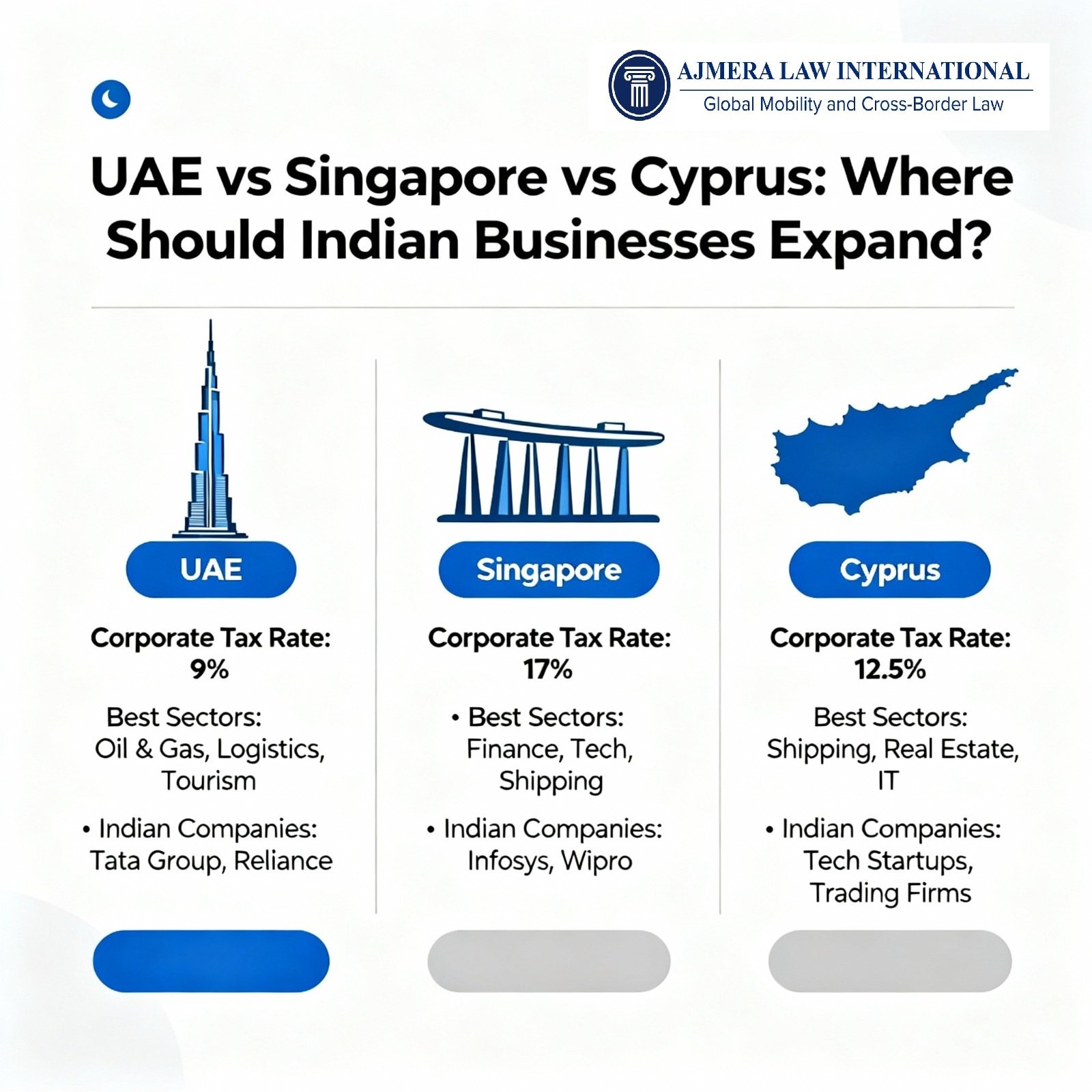
  • Tax: Attractive corporate tax rate (17%) and incentives for startups.

3. Indian Legal and Tax Considerations

  • Taxation: Income from foreign branches is taxable in India, but DTAAs may reduce the burden.
  • Transfer Pricing: Comply with Section 92 of the Income Tax Act.
  • Reporting: Annual reporting of overseas investments and earnings to RBI is mandatory.

4. Practical Steps for International Expansion

  • Research Host Country Laws: Entry barriers, labor rules, local tax structures.
  • Obtain RBI Approvals: Submit all required documentation under FEMA.
  • Consult Experts: Engage legal professionals versed in both Indian and international regulations.
  • Monitor Compliance: Keep all reports and filings up to date for FEMA and RBI.

Conclusion

International expansion is an exciting opportunity for Indian businesses, but navigating foreign investment laws demands diligence and expert knowledge. By adhering to RBI’s FEMA guidelines and understanding host country requirements, companies can ensure smooth, compliant overseas operations and build a strong global footprint. This guide empowers decision-makers to proceed confidently and legally as they venture into new international markets.

FOR BLOG- The author of this article is Mr. Prashant Ajmera, an Indian immigration lawyer and Canadian citizen. He is the founder of Ajmera Law Group and the author of two books, “Millionaires On The Book” and “How to Plan for Your Child’s Foreign Education.” Over the past 30 years, he has assisted and advised over 30,000 students and families on planning their foreign education and settlement. He regularly speaks at various forums on this subject.

Ajmera Law Group: Mo: +91 9974253030 | info@ajmeralaw.com | www.ajmeralaw.com


1